SUBSIDIES IN TURKEY AND THE WORLD (PART 1)
THE TURKISH TIMESl APRIL 15-
Screwball Economics, Voodoo Financing:
Subsidies, a Thing of the Past?
ANALYSIS BY ERCUMENT KİLİC
Part 1 of 2
It was 5:00 o'clock in Ankara in February of this year, I was making my way to Esenboga Airport. Driving trough Dikmen and Asagi Ayranci, relatively well to do segments of Ankara, I witnessed something which became the subject matter of this article; the bread lines.
'Apparently, all over Turkey now, such scenes are a part of daily life and this disheartening scene on my part has been a major topic of discussion in the media for an extensive period of time. There doesn't pass a day in Turkey that a news item related to, bread lines is not printed; some sad, some curious; from articles on the newly emerging, more affordable, "stale bread" ("bayat ekmek") market, to articles stating: "consumption of bread, despite consumer subsidies fell from a daily 12M to 8M in Istanbul" respectively.
Further self induced study and self provoked thought brought out two results: One, 1 was sad to see Turkey swallowed so far deep into this black hole called subsidies, currently with no hope of a propelling action to spin itself out of this endless cycle and two, to see that this monster of subsides being a global disease especially in underdeveloped and the so called developing countries.
Along the lines, there is good news and bad news on the matter of subsidies and the breadlines in Turkey.
Good news #1: TURKEY IS NOT ALONE: Turkey is not the only country where such re employed, Turkey is not the first country where lines of sorts are a part of daily scene. As a matter of fact, the reason the lines of people in the US for instance are invisible is because the supporting bureaucratic system and the related work force are ‘’ efficient’’ enough to do the job through means other than actual lines of people on the streets.
Established in 1862 by President Abraham Lincoln for instance such a work, force. in this country, the Department of Agriculture (USDA) has become one of the largest agencies in the Federal government with more than 120,000 employees. For every four full time farmers in the US there is one USDA bureaucrat on the payroll.
Good news #2 THERE MAYBE , GOOD SUBSIDIES: An analyses of subsidy policies for industrial and developing countries in four sectors: energy, road transport, water and agriculture may show that not all subsidies are "bad" and indeed, that there may be "good" subsidies. In fact, what makes the subsidy issue so complicated is that the difference between beneficial and harmful subsidies may well lie in the details.
A BRIEF WORKSHOP ON THE CONCEPT OF SUBSIDIES before going into “bad”.
A definition of a subsidy is that it is a payment of money or another form of an aid that the government gives to a person, organization or businesses. It’s purpose is to encourage some needed activity by furnishing funds, free land, tax relief, or legal rights that might otherwise be lacking. And the subsidies come into two shapes and forms: Consumer subsidies and production subsidies.
When governments grant production subsidies, what is mind is to provide a leveled playing ground for domestic businesses who may need to compete with foreign competitors, or to encourage private sector contribution to national economy. In the 1800’s for instance, the United States government gave large tracts of land to the railroads on the condition that they would build lines across the continent. Altogether, the railroads received about 160,000.000 acres (64,700.000 hectares) of land in this way. The government also granted subsidies to telegraph and cable companies. In the 1920s, it granted subsidies to ship companies. It gave them generous mail-
Governments can also impose a guaranteed minimum price above market level. In this case, government policy also subsidizes production.
A consumer subsidy on the other hand-
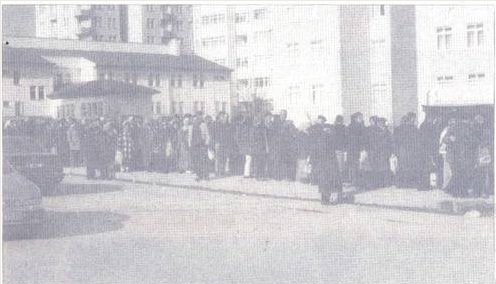
Residents of Ankara in bread line early in the morning. February 2002.